Thursday, 18 February 2016

Remember when Konami was Cool?

When Konami was cool


Unlike today where Konami is recognized as the foil to Hideo Kojima’s “Folk Hero”. There was once a time where Konami was considered cool and innovative,
And part of that time, was in the good old 90’s.

Today I’m going to be taking a look back at 1991 specifically for two very different games, on two very different platforms.
Sunset Riders for the Arcade, and Super Castlevania for the Super Fiacom/Nintendo.

Now in order for me to explain what makes Sunset Riders so great; we need to go back one year, to 1990.

Konami’s Teenage Mutant Ninjas Turtles beat ‘em up was enjoying overwhelming success. The staff at Konami soon discovered
That: it was not only the fact that the game was from one of the most popular IP at the time, keeping their machines fat with quarters
But, also the simultaneous gameplay for to 4 players. This being the 90’s, everyone knew the only place to get really good multiplayer was the arcade, and Konami saw this as
An opportunity to start making more multiplayer/co-op arcade games. 


Fast forward back to 1991 and Sunset Riders is released. Directed by Hideyuki Tsujimoto and published by Konami.

Set in the Wild West as a “Run n Gun” (not to be confused with shoot em up. Think Contra, not Galaga.), Sunset Riders features 4 playable bounty hunters: Steve, Billy, Bob, and Cormano. Each of the 4 characters is assigned to one of the control spots at the arcade machine and feature slightly different weapons.
Steve and Billy use revolvers, Bob a rifle, and Cormano a shotgun.
Characters are controlled with 8 way joysticks, a shoot button, and a jump button. Basic, but hey it worked for Contra.
Unlike contra the game featured a slide dodge mechanic rather than laying prone to avoid enemy gunfire.
At the beginning of each stage the players are shown a wanted poster of the stage’s boss showing their bounty value.


The players move through the multi-tiered, side scrolling levels making their way to the boss. The player who deals the most damage against the boss receives bonus points.
There’s plenty of cool power ups like a sheriff star that gives you full auto, or one that grants you a second gun allowing for multi directional fire. There’s even two stages on horseback.


Although the game didn't do anything revolutionary for the genre it was still fun and brings back great memories.


Super Castlevania IV
Unlike Sunset Riders, Castlevania is a series with a storied past and a fantastic legacy. One of the fan favorites of that legacy is Super Castlevania IV.

Directed by Masahiro Ueno, Produced by Kazumi Kitaue, and developed by Konami for the Super Nintendo/Fiacom video game system.

Masahiro Ueno who was the lead programmer was making his first ever 16 bit game. He loved the pure action of the original Castlevania  and wanted to make something similar to it.
This resulted in what was actually a soft remake of the original for NES.
The game puts you back in the boots of Simon in 1691 Transylvania, on his quest to slay Dracula. A lot has changed this time around though especially when it comes to Simon’s arsenal. Among many of the improvements to the actual gameplay:

·     The ability to swing the whip in all 8 directions of the d pad

·     Holding the attack button results in a multi-hit spin attack that also block enemy projectiles. (a staple in the future games.

·     Simon’s whip can also latch on to grappling points to swing across large gaps too wide to jump.

·     Simon can move while crouching

·     The length and attack power of the whip can be increased twice by finding two different upgrades.
          

All of these improvements came to fruition during the development process. Its thanks Masahiro Ueno commitment to making the game less frustrating for players when compared to its 1987 original.

Because the team was so small during the development process; there was a lot of cross pollination that happened between artists and programmers when it came to creating the maps.

Early bosses in the game were also designed to be more user friendly by being easier, and having discoverable weak points that could be exploited with the secondary weapons. Further more difficult bosses were made with detailed attack patterns. Neither of these were possible on the NES original either.
Since its initial release, to this day, Super Castlevania IV is still praised for perfecting the classic formula; and that’s a very good thing.


If it wasn't for Super Castlevania IV, the BEST Castlevania game ever would probably would have never been made.

But that’s a story for a different time.

Image Credits

www.vizzed.com
www.chapleofresonance.com
http://www.telebunny.net/toastywiki/index.php/Games/G10-SuperCastlevaniaIV

Wednesday, 10 February 2016

1987, the greatest year of video game franchises.


Now of course this opinion is a little biased; being born in 1987 myself, however some of the world’s most iconic and contemporary franchises did in fact make their first appearance in 1987.

Some of the franchises you may be familiar with are as follows.

·         Metal Gear

·         Street Fighter

·         Mega Man

·         Final Fantasy

·         Double Dragon

Some of these franchises were very revolutionary in inventing entirely new genres out of necessity.


Metal Gear 


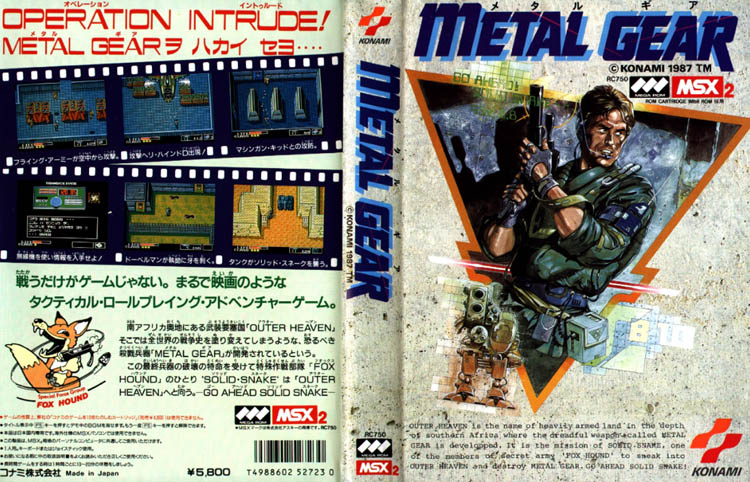
Metal Gear Solid V: The Phantom Pain (the 11th Title in the franchise) released recently to commercial and critical success, but perfection needs to start somewhere; and that place is 1987.
Hideo Kojima; one of the greatest game designers in the world, created Metal Gear for the MSX2 home computer in Japan while working at Konami. Although Metal Gear was originally intended to be
A modern military action game, the hardware limitations of the MSX2 only allowed to process a limited number of bullets and enemies on screen at a time. Kojima felt that this impeded
The combat and flow of action.

To get around this, Kojima; inspired by the World War II film “The Great Escape”, altered the game to be based around evading enemy capture. And thus, the stealth action genre is born.
The player controls Solid Snake, a rookie in the Foxhound Special Forces unit. He is sent to the eastern pacific fortress called Outer Heaven to rescue his missing squad mate and investigate a weapon Called Metal Gear.

When a player enters a room it is comprised of a single screen, being patrolled by several guards. The player must use the environment and patrol patterns of the guards to sneak past them. If a player is spotted by a guard in the Screen they currently occupy, one exclamation appears over their head. The player must now fight them or escape to one of the other screens. If two exclamation points appear (either by not using a suppressor while killing someone,
or being spotted on camera/via infra-red sensors), the enemy solider has set off an alarm, and all the in the stage are on alert. Snake must now defeat all the enemy soldiers, or escape through an elevator.  


Regular Grunts weren't the only type of enemy the player encounters, there are also several boss enemies peppered throughout the game. 


Although a trend setter in many ways, multiple bosses and an inventory system were a popular staple in games of that era, and are still used today.
We can only be certain that the next game Kojima creates will also be a trendsetter.


Street Fighter


Street Fighter V is only 6 days away!  This legendary fighting game franchise is finally getting its “come upins” as an e-sport. However, the first game is a far cry from what is about to be released next week on the PlayStation 4 and PC.
Produced and directed by Takashi Nishiyama, and planned by Hiroshi Matsudo. Both would leave Capcom after the initial release of the First Street Fighter to go work for SNK, where they created some of the other popular fighting game franchises
Such as Fatal-Fury and Art of Fighting.

The player begins the game as Ryu; A Japanese martial artist, he’s competing in an international martial arts to prove his strength. Player 2 takes control of Ryu’s Training partner Ken. The Characters are only pallet swap,
Everything else about them is the same.
 
In single player mode, the player must defeat 10 different opponents from 5 different countries in 1 v.s. 1 matches. When starting, the player can choose which country they begin in. You must now use Ryu to defeat two fighters from that country
Before being able to move on to the next country in the tournament. After defeating the first 8 opponents, the player heads to Thailand where the final 2 opponents wait.


The player uses an 8 way directional joystick, and 6 attack type buttons to fight: 3 punching buttons Light, Medium, Hard, and 3 kicking buttons Light, Medium and Hard. 

The player was able to move forward, back, jump and crouch during combat,
And was even able to execute special attacks when entering a specific sequence of directional queues and attack button inputs. 


Street Fighter was a trend setter when it came to not only special moves, but the ability to block, and jump in a fighting game. Street fighter was also the fighting game to set the
Standard 6 button layout, however this was only after Capcom decided to do away with their pressure sensitive attack button lay out (also a first).

The arcade game initially released in two different versions:

·         The Regular Version: table top in Japan, Upright in America, 6 button.

·         The Deluxe Cabinet: two pressure sensitive pads that measure the speed and strength input for light medium and hard.


Design is king when it comes to the success of a franchise and the 6 button layout is not only the standard for Street Fighter (even 5 coming out next week) but all fighting games. The 6 button layout also led to the development of the Home “Fight Stick” and “Fight Pad”.
I can’t wait to get mine next week.


http://store.madcatz.com/categories/fightsticks-category/Street-Fighter-5-FightPad-PRO-for-PS4-PS3.html


Thursday, 21 January 2016

Prepare to Die Again, For a third time.....No really.

“Now Only Embers Remain.”


Gamers everywhere are DYING in anticipation for the next instalment in the Souls series simply titled Dark Souls 3.

For those unfamiliar with the (as fans dub it) “Souls” series, it is a collection of Action-Role playing games created and developed by the Talented team at FromSoftware.
The series is played in third person perspective with a difficult yet satisfying melee and magic real time combat system that keeps your glutes clenched one hundred percent of the time.
Travelling through desolate lands, castles, forests, mountains, swamps, and just about any other type of terrain you can think, players simply explore and play until you find the last boss.

The majority of enemies you face are disfigured undead people and creatures. Some enemies use physical attacks and others use magic. Then you also get to fight huge unique boss enemies like a Flying suit of armor, or a giant spider that shoots a laser.
Amazing enemies and character builds aside, one of the biggest draws for people to the series is the lack of “hand holding” the game provides and encourages exploration.

There are no maps, no way points and only simple cryptic instructions provided by the very few friendly NPCs you find throughout the game. This refreshing design is all thanks to current president of FromSoftware and father of the Soul’s series, Heditaka Miyazaki.

Miyazaki San, began working at FromSoftware in the heyday of the PlayStation 2. During this time, he worked as a programmer on the Armored Core series.
Just 5 years after starting at FromSoftware Miyazaki San went from programmer to Creator/Director/Producer on the first game in the Souls series “Demon’s Souls”.
Released in 2009 exclusively for the PlayStation 3, this was the game that laid the groundwork for what would become one of the most popular contemporary video game franchises.

Many of the features that appeared in Demon’s Souls would carry over into the other iterations of the series. Some of the most notable features would be:

·    Fully Customizable Character Creator
·       Melee combat that allows control of many weapons in various stances.
·       A weight system that affects the player’s movement speed both in and out of combat.
·       Magic attacks
·       The ability to summon other players into your game for co-op help.


The biggest difference between Demon’s Souls and the rest of the series however, is Demon’s Souls “Hub” world.

This is the only game in the series to feature a separate area from any field of combat with different portals used to travel to different lands where progression takes place.

Dark Souls, the spiritual successor to Demon’s Souls released to much hype in fall 2011. This follow up took everything from the original, improved it one hundredfold. Although originally only released for the PlayStation 3 and the Xbox 360, the game hit such a critical mass, that it even received a PC port the following year.

One of the biggest changes made in Dark Souls from Demon’s Souls, was the removal of the Hub world, in exchange for a giant seamless open world. The most fascinating part is that many of the different gruelling paths you travel eventually lead you back to the start of the game: “The Firelink Shrine.”

More Bosses, more lore, Dark Souls got so popular it even received DLC. Once people beat that, everyone started clamoring for another entry, and boy did they get one.  


Image Credit to:

Thursday, 14 January 2016

This is the place where I will pierce the video game industry.


Hi my name is Justin Rycaj (Ritz-eye) yes that's how you pronounce it. I should probably consider getting it phonetically printed on my business cards once I get them made. But that's neither here nor there.

So I guess I should preface by stating the two reasons why I came to the Art Institute of Vancouver for Video Game Design after hearing how highly it ranked:

1. To make my dreams come true.

2. To achieve Greatness!  

It all started back on my fourth birthday, my first real memory of video games. I received a Nintendo entertainment system with Super Mario World 3 and Final Fantasy (oooo ahhhhh). Although most kids at that age would have probably drawn to Super Mario, The Box art for Final Fantasy probably imprinted on to me much more, and invoked what could quite possibly be my first ever desire for Adventure.

Sure I didn’t really understand the combat mechanics, nor did I get very far, but if you had lined up the entire Mario Cast and Final Fantasy side by side; I’d always pick the Final Fantasy characters are being cooler and more interesting. That original box art from Final Fantasy still flickers in my mind any time I feel like playing Dark Souls or Bloodborne.

Oddly enough I didn’t get another home console until the PlayStation One. Sure I had a Game Boy, Game Gear, and a home computer, it’s just up until the time the PS1 came out, nothing really lit that fire of adventure like Metal Gear Solid (Been a PlayStation fanboy ever since).

Metal Gear was the first time where I felt like “video games are growing up with me.” If you look over the course of the Past 28 years, the Metal Gear franchise has shown the most evolution out of any other series which is why I respect Hideo Kojima so much. This is also probably one of the reasons why I don’t like Nintendo games anymore, they stay the same and their mascots seem more like crutches than anything these days. But I’m not here to slander.

Getting back on topic. It’s very hard to argue that Hideo Kojima isn’t one of the hardest working, and best creators/producers we have in the industry. It’s a shame that Konami’s Gag order prevented him for accepting his award at the 2015 VGAs. It was a really dumb move by Konami and has pretty much painted him as a folk hero now. 
This is also evident by all the love he’s been getting since it happened, and the recently announced partnership with Sony to Open the New Kojima Productions.
If you had to ask me who my favorite producers were based on their bodies of work would have to be (in no particular order):

Hideo Kojima – Metal Gear Series
Neil Druckman – The Last of Us, Uncharted Series
Hidetaka Miyazaki – The Dark Souls Series


Ultimately my goal would to be a Creative Director/ Producer half as good as them. Hopefully my diploma will give me a jump start to reaching that goal.